
Investment 360 Index 2026
Ten years into the Investment 360 Index, UK dealmakers have expected a recovery for four years running, so why hasn’t that optimism turned into deals?
For four years, the management teams, investors, lenders and advisers who complete CIL's Investment 360 Index survey have told us they expect deal activity to rise. For four years, it hasn't.
This year's Index, our tenth, lands weeks before John Healey's first Budget on 28 October 2026. It points to a market with money to spend and the will to do deals, but not yet the confidence to act. So what's holding it back and what would change that? Here's what the data is telling us.
93%say political churn has damaged the business climate |
66%expect business tax rises at the Budget |
51%still expect deal activity to rise next year |
~320UK buyout and growth deals per year since 2023, down from 519 in 2020/21 |
Source: CIL Investment 360 Index 2026, 181 respondents. Deal volumes: Preqin, year to September. The latest figure is likely to be revised upwards as more deals are disclosed.
The end of cheap money and a two-speed market
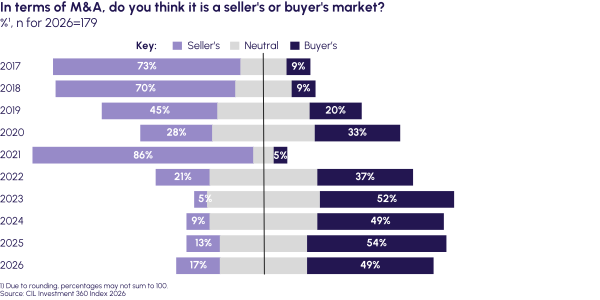
When the Index began in 2017, 73% of respondents saw a seller's market. By 2021, at the height of cheap money, that figure had reached 86%. Today, almost half of respondents see a buyer's market.
Our reading is that the end of near-zero interest rates has changed the maths of a deal. At 3.75%, rates are reasonable by longer-run historical standards. But higher interest rates mean leveraged deals now need much stronger EBITDA growth to achieve a satisfactory return than before COVID, so buyers apply far more scrutiny before committing.
The result is a market moving at two speeds. Private equity still holds significant capital, but it is increasingly selective. The most differentiated assets attract strong competition and premium prices, and the share of respondents who see a seller's market has risen for three years running, but only to 17%. Average assets face thin buyer pools, valuation gaps and processes that drag or fail. This matches the experience of many in the M&A community: more false starts, longer processes, and passable assets that would have transacted in 2021 failing to sell.
For business owners, the question is no longer whether it's a good time to sell, but whether their business is in the top tier.
What you told us
It ought to be the buyer's market, but vendors still hold on to mythical multiples of yesteryear, so the valuation gap remains.

If you have a high quality asset, there remains a large amount of capital that is chasing relatively few opportunities.
Ongoing tinkering with tax infrastructure makes long-term investing and decision-making fraught with difficulty.
Symptoms or causes? Why deals haven't come back
This isn't a new pattern. Every year since 2023, most respondents have expected deal activity to rise, though that optimism has cooled, from over three-quarters in 2023 and 2024 to around half in 2025 and this year. Yet UK buyout and growth deals have held at around the same low level, roughly 320 a year.
If the market has adjusted to a higher-rate world, why are volumes still subdued? Here's what the data says about the usual explanations.
Is it the cost of borrowing? Not really
Bank Rate has been cut six times since its peak and, at 3.75%, is reasonable by longer-run historical standards. 64% of respondents think credit markets are "just right", close to the most positive reading in the Index's history. The Bank Rate is not what is stopping deals.
Is it a lack of capital? No, it's selective
UK dry powder is near record highs, but it is choosy. And because fundraising has fallen sharply, the capital that exists is ageing, which would normally mean a pressing need to deploy. Instead, it competes hard for the best assets and passes over the rest, which is why a market with plenty of funding can still feel like a buyer's market for most sellers.
Is it politics? Partly
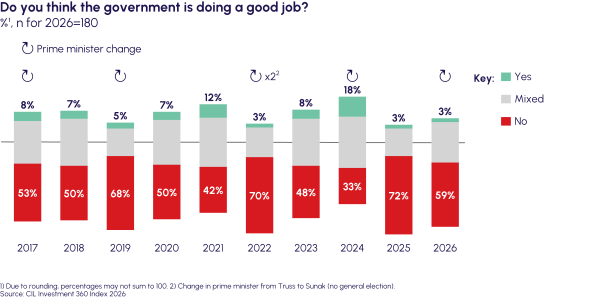
93% say frequent changes in political leadership over the last ten years have damaged the business climate. But this community has never had much faith in government: across ten years and every change of prime minister, the share saying the government is doing a good job has never risen above 18%. Pressures aren't only domestic either: geopolitical risk has tripled as a factor in strategic decisions according to respondents, from 5% to 15% of mentions.
The most pressing worry is tax
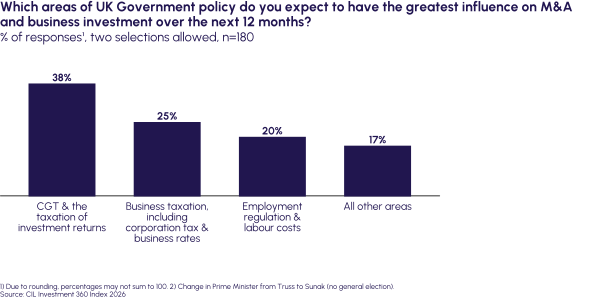
Two-thirds of respondents expect business taxes to rise at the Budget. Asked which areas of policy will most influence M&A over the next 12 months, respondents put capital gains tax (CGT) clearly first, with 38% of responses, ahead of broader business taxation (25%) and employment regulation (20%). CGT matters both to owners deciding whether to sell and to private equity houses, through the treatment of carried interest. In the short term, uncertainty over CGT distorts deal timelines: rumoured rises brought deals forward in early 2021 and again in the second half of 2024, ahead of Rachel Reeves' first Budget. But the deeper concern is structural. Following the increases in 2024, a further major rise could make many deals unviable and make the UK materially less attractive to private equity.
The Uncertainty Cycle
Inflation shocks, political uncertainty and a tight fiscal position have followed one another. Each Budget brings the threat of tax rises, and each new shock gives buyers and sellers another reason to wait.
What this means for you
- If you're selling. The best assets generate increasingly competitive processes and strong prices. Getting there takes preparation: a data-backed growth story with clear value creation levers. If your business isn't in the top tier, be realistic on price, know your likely buyers and build a credible story around what they're looking for.
- If you're investing. Capital is plentiful, but the bar is higher. Early, pre-deal value creation planning is the edge, particularly for good businesses just below the top tier, where competition is thinner. It gives you the conviction to be the top bidder.
- If you're buying. Corporate management teams are the most positive group about the M&A environment. With private equity being increasingly selective and some sellers adjusting expectations, well-prepared acquirers can win deals and benefit from lower multiples. Be clear on your synergy plan, so the value comes from improving the business, not just from buying at a lower price than you'll later sell for. Future buyers will expect it.
What will break the cycle?
Many of the conditions for a recovery are already in place. Valuation expectations may be easing, credit is available, rates are currently reasonable, and the backlog of businesses that private equity will eventually need to sell keeps growing. What the market lacks is the confidence to act. Three things could restore it:
- Certainty on tax. A budget that settles the question of capital gains and business taxes, rather than leaving it open for another year, would remove one of the most persistent reasons to wait.
- A calmer world. An end to geopolitical conflicts and a fall in energy prices would ease the inflation pressure that keeps rates from dropping further.
- A productivity step-change. If AI begins to deliver the productivity gains many expect, it could lift the growth outlook that underpins valuations.
After four years of expected recoveries that didn't arrive, we're wary of predicting this one. But the first test is close: the Budget on 28 October. We'll be looking at what it means for deal-making once the detail is known.
“There is capital and suitable leverage to do deals; what’s missing is confidence. A Budget that settles the tax question would help, but the real acceleration would come from a period of stability long enough for sellers to flourish and buyers to commit.

About the Index: Since 2017, CIL's Investment 360 Index has tracked the views of management teams, private equity investors, debt providers, corporate financiers and advisers on the UK economy and investment environment. The 2026 survey ran in September and received 181 responses: 33% from corporate management teams, 30% from private equity and debt providers, 19% from corporate finance and investment banks, 10% from advisers and 7% from others.