
Why organic growth matters in wealth management
Organic growth is emerging as the key differentiator in wealth management. Using CIL’s Organic Growth Index, this analysis explores what separates the sector’s true outperformers.

Most wealth management (WM) businesses can point to headline growth. Far fewer can show sustained outperformance once market movements and acquisitions are stripped out - and it is that difference that increasingly drives long-term value.
In a sector where M&A has long dominated the growth playbook, genuine organic growth has become rare. To separate momentum from noise, we have developed CIL’s Organic Growth Index, which sets a baseline for what ‘passive’ growth looks like in the absence of meaningful net new client inflows. Businesses that consistently outperform that baseline stand apart.
For investors, organic growth is a clear signal of quality. For management teams, it highlights the harder-to-build capabilities that underpin resilience: repeatable client acquisition, productive advisers and operating models that scale. As external tailwinds fade, these distinctions matter more than ever.
What drives growth in wealth management
WM revenue growth ultimately comes from two sources: expanding assets under management (AUM) and increasing the yield captured from those assets. Increasing the total fees charged to the client is hard to achieve – these rates are broadly market-set. Vertical integration of discretionary fund management and investment advice rebases the yield higher by capturing more of the total fees, but does not provide an ongoing growth engine. That leaves AUM expansion as the truest driver of sustainable growth.
AUM can be driven through three levers: net new client wins, net accumulation from existing customers, and market performance. Of these, winning new clients is the strongest differentiator and the key to organic growth. Net accumulation matters too, but it depends largely on client profile and selectivity. A long period of stock market growth has flattered many businesses’ revenue profiles, masking who is truly outperforming.
Why organic growth matters
Organic growth reflects capabilities that cannot be bought overnight: scalable sales engines, strong adviser talent and efficient operations. These qualities compound over time, creating sustainable competitive advantage that investors consistently reward with higher valuations. For WM businesses themselves, building these capabilities makes them both more attractive to buyers and more resilient in their own right.
By contrast, vertical integration or one-off pricing plays can provide short-term uplift but lack the compounding benefit of adding new, accumulating clients. And while M&A has offered a faster route to scale, rising debt costs and intense competition for high-quality, integrable assets are eroding multiple arbitrage, which has been the principal engine of value creation in the sector to this point. With more than 40 PE-backed platforms already active in the UK, inorganic growth alone is no longer enough to stand out
Benchmarking the sector
CIL’s Organic Growth Index sets a baseline for organic growth in a firm that isn’t substantially adding new clients, and is based primarily on stable advice fees, typical accumulation behaviour and known market movements over the period analysed. For 2022–24, our analysis indicates this ‘passive’ baseline sits at roughly 5–6% a year. WM businesses need to outperform this baseline to be truly outperforming organically.
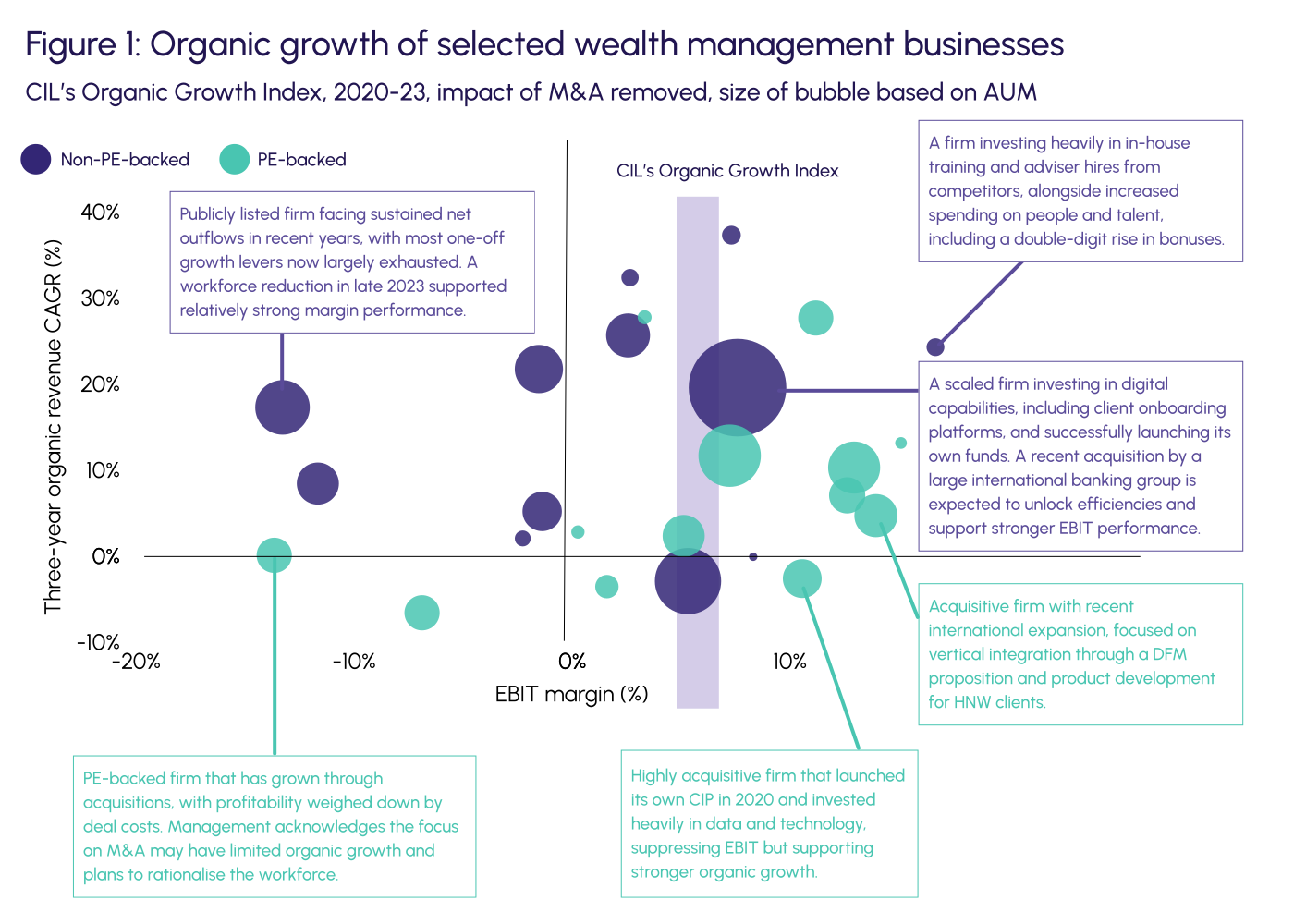
Our analysis of financial statements from 25 WM businesses, representing around £250bn in AUM - roughly a quarter of the UK market - shows a wide range of performance outcomes either side of this benchmark, once adjusted to remove the impact of acquisitions.
While many WM businesses can demonstrate growth at or around this level, few deliver the kind of sustained outperformance that drives long-term value. For investors, it’s a clear signal of a high-quality business. For management teams, it highlights the capabilities needed to build to create a stronger, more resilient business.
Figure 1 shows the spread: some businesses outperform the benchmark, typically due to investment in adviser talent, digital capabilities or new product launches. Others, particularly those reliant on acquisitive strategies, show weaker resilience, with many having already exhausted the one-off revenue growth arising from vertically integrating a discretionary fund management (DFM) proposition alongside planning.
What outperformers do differently
Our analysis highlights the strategies that set outperformers apart. One business, for example, has invested heavily in in-house training and competitor team lifts, showing a commitment to the human capital drivers of growth in this sector.
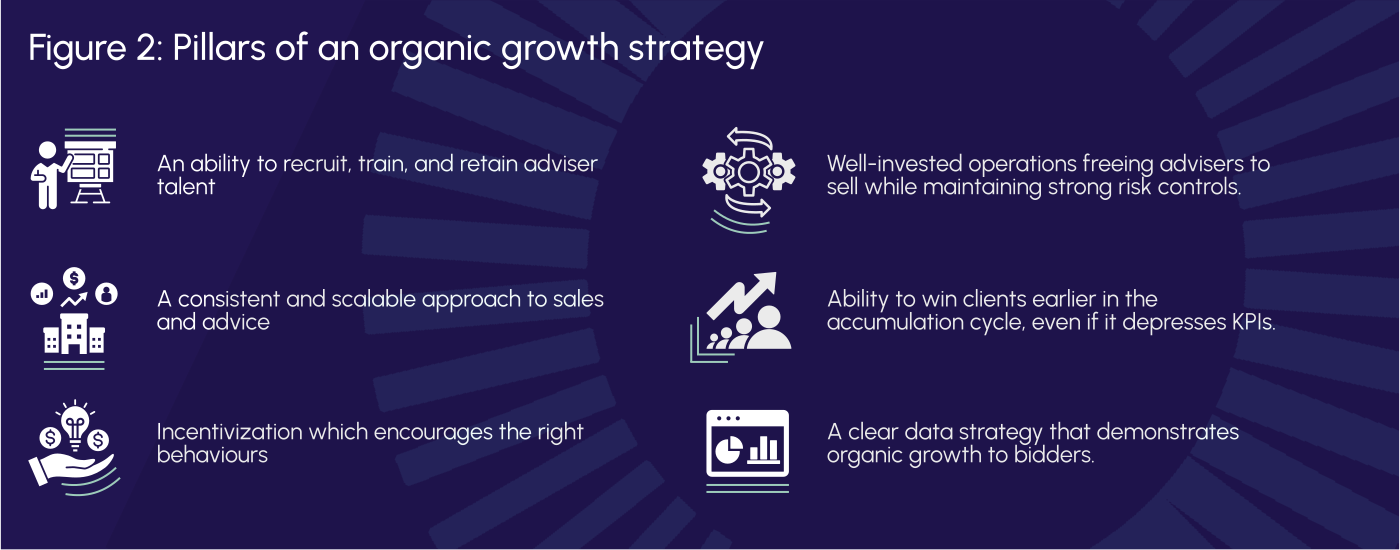
What sets the strongest businesses apart is how these elements fit together. They pair adviser recruitment and training with scalable, consistent advice processes, robust operations and incentive structures that drive the right hunting and farming behaviours. They engage clients earlier in the accumulation cycle, even if it suppresses short-term KPIs, and they develop data capabilities that enable better management control of growth levers and articulate sources of organic inflows to prospective buyers. Together, these pillars form the foundation for sustained outperformance above the 5–6% baseline index (see figure 2 below).
By contrast, businesses that have relied heavily on acquisitions are now feeling the strain. Deal costs, integration challenges and a lack of investment in organic levers have left them less profitable and with weaker equity stories. Several PE-backed consolidators admitted their focus on M&A has limited their ability to deliver organic inflows, forcing them to rationalise staff or rethink strategy.
A sharper lens for investors
For investors, the implication is clear. With M&A-driven growth facing diminishing returns, the real prize lies in firms with a genuine organic engine. The Organic Growth Index provides a practical benchmark: those who outperform it are building capabilities that compound, sustain and justify premium valuations.
For WM businesses themselves, the message is just as important. Businesses that focus on organic growth - through talent, technology, operational strength and client engagement - will not only secure stronger valuations at exit but also build more durable and competitive businesses along the way.
What comes next for the sector?
The valuation environment that has supported wealth management in recent years is becoming harder to sustain. Slower markets, weaker UK wealth creation and rising regulatory demands are reducing the extent to which passive AUM growth and multiple expansion can underpin value.
Consolidation-led strategies are therefore under increasing pressure. The scope for meaningful synergies between vertically integrated platforms is limited once one-off fee rebasing has been realised, and further multiple arbitrage is harder to achieve. For some consolidators, exit routes are becoming more dependent on a recovery in public markets than on continued private market roll-up strategies.
Pure-play advice businesses retain strong exit potential, but the bar is rising. Scale alone is no longer enough. Investors are increasingly focused on the sustainability of organic inflows, adviser productivity and client accumulation, rather than on short-term revenue uplift from vertical integration.
Regulation will continue to shape market structure. Restricted advice models offer greater consistency, simpler oversight and more scalable operating models, supporting organic growth - though adoption remains uneven across the sector.
Overall, the outlook reinforces a central conclusion of this analysis. As external tailwinds fade, organic growth becomes the defining differentiator. Firms that can consistently outperform the baseline will be best placed to defend valuations and stand out in a more selective investment environment.
We continue to monitor trends and activity in the financial services and wealth management space. If you would like to discuss key developments or strategic opportunities, please get in touch.